





One day, your child is reading the classroom board without difficulty. A few months later, they are squinting at the television or asking to sit in the front row. It can feel as though children are reaching for glasses earlier than ever.
Parents are not imagining the change. Myopia in children—commonly called short-sightedness—is becoming more common. One Indian analysis estimated that myopia among urban children aged 5 to 15 rose from 4.44% in 1999 to 21.15% in 2019. However, the explanation is not simply that “screens have damaged their eyes.” It involves how children learn, play and grow, along with family history and better eye screening. To know more
What Does It Mean When a Child Needs Glasses?
Children may need glasses for several refractive errors. Myopia makes distant objects appear blurred. Hyperopia, or long-sightedness, can make close work difficult in some children, while astigmatism can blur or distort vision at different distances.
The condition receiving the most attention is myopia. It usually develops when the eye grows too long, causing light to focus in front of the retina rather than directly on it. Myopia commonly begins during the school years and may continue to progress while the child is growing. To know more
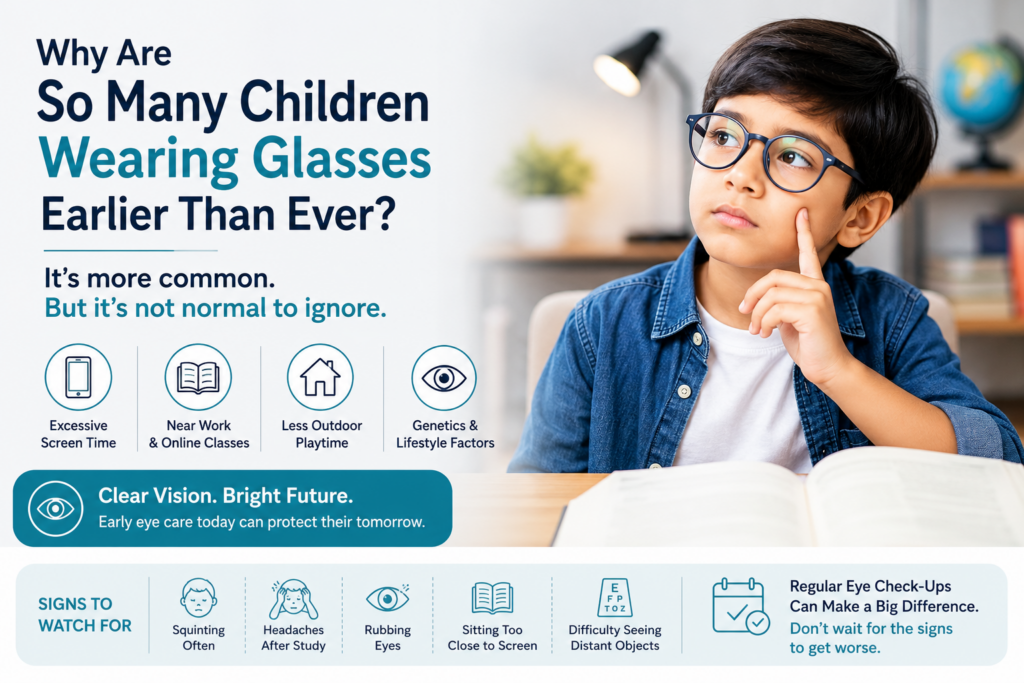
Why Is Myopia Appearing Earlier?
1. Children are doing more close-up work
Homework, reading, smartphones, tablets and gaming keep the eyes focused at a short distance. Research links longer periods of near work and screen use with a greater likelihood of myopia. How close a device is held and whether the child takes breaks may also matter.
This does not mean every child who uses a tablet will need glasses. Screens are part of a wider pattern of near work; a printed book held very close for hours also counts. The aim is balance, not fear of technology.
2. Outdoor time has decreased
This may be the most overlooked factor. Children who spend more time outdoors are less likely to develop myopia. Researchers are still studying why, but brighter outdoor light may help regulate eye growth.
The World Health Organization encourages children to spend at least 90 minutes outside each day. Walking, cycling and playing in the garden all count. Sensible sun protection should still be used.
3. Genetics still matter
Lifestyle is not the whole explanation. A child has a higher chance of developing myopia when one or both parents are myopic. Genetics does not make it inevitable, but children with a family history may benefit from closer monitoring.
This is why two children with similar routines may have very different eyesight. One may develop myopia early, while the other may never require glasses.
4. Eye problems are being detected sooner
More children wearing glasses is not entirely bad news. Awareness, school screenings and access to eye examinations have improved. Some children in earlier generations also had refractive errors; they simply remained undiagnosed.
Therefore, the visible rise in glasses reflects two trends: more children may be developing myopia, and more children who need vision correction are receiving it earlier.
Are Glasses a Sign That a Child’s Eyes Have Become Weak?
No. Glasses do not weaken the eyes or make them “dependent.” They focus light correctly so the child can see clearly. Avoiding prescribed glasses does not train the eyes; it can leave a child struggling in class or during play.
Early correction supports learning and normal visual development. In some cases, an untreated refractive error can contribute to amblyopia, commonly known as lazy eye, in which vision does not develop properly.
Signs Parents Should Not Ignore
A child may not say that their vision is blurred because they assume everyone sees the same way. Watch for:
- Squinting to see distant objects
- Sitting unusually close to the television or classroom board
- Holding books or devices very close
- Frequent eye rubbing, eye strain or headaches
- Closing one eye or tilting the head to see
- Losing interest in reading
- Unexplained difficulty at school
These signs do not automatically mean a child needs glasses, but they do justify an eye examination.
What Can Parents Do?
- Small, consistent habits matter more than a temporary screen ban.
- Make outdoor time part of every day, aiming for at least 90 minutes when practical.
- Encourage regular breaks during reading, homework and screen use. The 20-20-20 rule—looking about 20 feet away for 20 seconds every 20 minutes—can help reduce digital eye strain, although it is not a guaranteed way to prevent myopia.
- Keep books and screens at a comfortable distance instead of very close to the face.
- Use adequate room lighting and avoid long, uninterrupted periods of near work.
- Arrange a comprehensive eye examination when symptoms appear, when myopia runs in the family or as advised by an eye specialist. School screening is helpful but may not identify every eye condition.
- Developing myopia at a younger age gives it more time to progress. High myopia can increase the risk of serious eye conditions later in life.
The Takeaway
Children are wearing glasses earlier because more learning happens up close, less time is spent outdoors and genetically susceptible eyes face different demands. Earlier detection also means fewer children silently struggle with blurred vision.
Glasses are not the enemy. Undetected or rapidly progressing vision problems are the greater concern. Healthy visual habits, outdoor play and timely eye examinations can help protect a child’s sight while their eyes are still developing.
If your child is squinting, sitting closer to screens or struggling to see the classroom board, a comprehensive paediatric eye examination at Shekar Eye Hospital can help identify the reason and determine the right next step.
Frequently Asked Questions
Does screen time directly cause myopia in children?
Screen use is associated with myopia, particularly when it involves prolonged close-up viewing and replaces outdoor time. However, it is not the only cause. Genetics, near-work habits and limited exposure to outdoor light can all contribute.
Will wearing glasses make my child’s eyesight worse?
No. Properly prescribed glasses do not weaken the eyes or worsen the power. They help the child see clearly. A child’s prescription may still change as the eyes grow, but this is not caused by wearing glasses.
Can childhood myopia be reversed?
Myopia generally cannot be reversed naturally. Glasses or contact lenses correct the blurred vision, while certain treatments may help slow its progression. An ophthalmologist can recommend the appropriate approach based on the child’s age, prescription and eye health.