

Explore Bangalore’s leading eye hospital which is Shekar Eye Hospital to find the best and most advanced options for Myopia treatment, ensuring comprehensive care for your vision needs. Myopia, commonly known as nearsightedness, is a prevalent refractive error where nearby objects can be seen clearly, but distant objects appear blurred. At Shekar Eye Hospital, we are dedicated to providing comprehensive care and management for patients with myopia, ensuring optimal vision and eye health.
What is Myopia (Nearsightedness)?
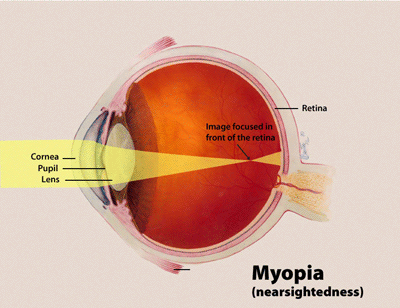
The eye functions much like a camera, focusing light onto the retina to produce a clear image. In myopia, the eyeball is elongated or the cornea has too much curvature. This causes light rays to focus in front of the retina, leading to blurry distant vision. Close objects, however, are seen clearly.
Causes and Risk Factors of Myopia
- Genetics: A family history of myopia increases the risk.
- Environmental Factors: Prolonged near tasks such as reading or computer use can accelerate myopia in predisposed individuals.
- Age: Myopia commonly begins in childhood and progresses until about age 20, but it can develop in adults due to visual stress or health conditions
Symptoms of Myopia
- Blurry vision when viewing distant objects.
- Squinting or closing the eyelids slightly to see clearly.
- Headaches are caused by eye strain.
- Difficulty in seeing while driving, especially at night.
Diagnostic Procedures
At Shekar Eye Hospital, we employ advanced diagnostic tools to measure refractive errors accurately:
- Visual Acuity Test: Using a standardized eye chart to determine the sharpness of vision at various distances.
- Refraction Assessment: Employing a phoropter and retinoscope to determine the eye’s refractive error and the best corrective lenses.
- Eye Health Evaluation: A thorough examination to rule out other eye conditions.
Treatment Options for Myopia
- Eyeglasses or Contact Lenses: The most common corrective measures for myopia. At Shekar Eye Hospital, we offer a range of high-quality lenses tailored to individual needs.
- Orthokeratology (Ortho-K): A non-surgical procedure using specially designed contact lenses to reshape the cornea’s curvature.
- Refractive Surgery: Procedures such as LASIK or PRK can be used to alter the shape of the cornea, providing a long-term solution for myopia.
Myopia Treatment at Shekar Eye Hospital
At Shekar Eye Hospital, we offer cutting-edge solutions for myopia treatment, providing personalized care to address nearsightedness effectively. Our experienced team of ophthalmologists employs advanced technologies and proven methodologies to tailor treatment plans, ensuring optimal vision correction. From innovative corrective lenses to state-of-the-art surgical interventions, our commitment is to guide patients towards clear, comfortable vision. Trust Shekar Eye Hospital for comprehensive myopia care, where expertise meets compassionate service for your visual well-being.
Prevention and Management
While genetic factors cannot be changed, certain practices can help in managing and possibly slowing down myopia progression:
- Eyedrops for Myopia Progression Control
- Glasses for Myopia Progression Control
- Encourage regular eye breaks during prolonged close tasks.
- Ensure good lighting while reading or working.
- Regular eye check-ups to monitor and manage progression.
Conclusion
Myopia is more than just a visual inconvenience; if left unchecked, it can progress and lead to significant vision issues later in life. At Shekar Eye Hospital, we are committed to providing holistic care for myopic patients. Our state-of-the-art facility, combined with our expert team, ensures that you get the best possible care for your eyes.
For further details, consultations, or to book an appointment, please connect with our dedicated team at Shekar Eye Hospital.
Frequently Asked Questions
How much does myopia treatment cost?
The cost of myopia treatment depends on the type of treatment recommended, your child’s age, the severity of myopia, and the management approach chosen. Options such as specialised glasses, contact lenses, low-dose atropine eye drops, or other myopia control treatments may have different costs.
A comprehensive eye examination is the best way to determine the most suitable treatment plan and provide an accurate estimate of the overall cost.
Which treatment is best for myopia?
There is no single treatment that is best for everyone. The most suitable treatment depends on factors such as the patient’s age, the degree of myopia, lifestyle, and whether the goal is to correct vision or slow the progression of myopia.
For children, myopia control treatments such as specially designed glasses, contact lenses, or low-dose atropine eye drops may be recommended to slow progression. For adults, glasses, contact lenses, or laser vision correction may be suitable depending on individual eligibility. Your ophthalmologist will recommend the most appropriate option after a detailed eye examination.
What is considered high myopia?
High myopia is a more severe form of nearsightedness in which the eye is significantly longer than normal, increasing the risk of serious eye conditions such as retinal detachment, glaucoma, myopic macular degeneration, and cataracts.
Can myopia worsen with age?
Yes. Myopia commonly progresses during childhood and adolescence as the eyes continue to grow. For many people, the prescription stabilises in early adulthood, although some individuals may continue to experience changes in their vision over time.
Regular eye examinations help monitor changes in your prescription and detect any complications associated with increasing myopia. Early management is particularly important in children to help slow its progression.
Can children’s myopia progression be controlled?
Yes. Although myopia cannot always be prevented, its progression can often be slowed with early diagnosis and appropriate treatment. Depending on the child’s condition, your ophthalmologist may recommend myopia control glasses, specialised contact lenses, low-dose atropine eye drops, or a combination of these approaches.
Encouraging children to spend more time outdoors, take regular breaks from near work, and attend routine eye examinations also plays an important role in supporting healthy eye development and reducing the risk of high myopia.
Can myopia be permanently cured?
Myopia cannot be permanently cured because it is related to the shape and growth of the eye. However, it can be effectively corrected with glasses, contact lenses, or laser vision correction in suitable adults, allowing many people to see clearly without relying on spectacles.
For children, the focus is on slowing the progression of myopia rather than curing it. Regular eye examinations and timely treatment help protect long-term eye health and reduce the risk of complications associated with high myopia.